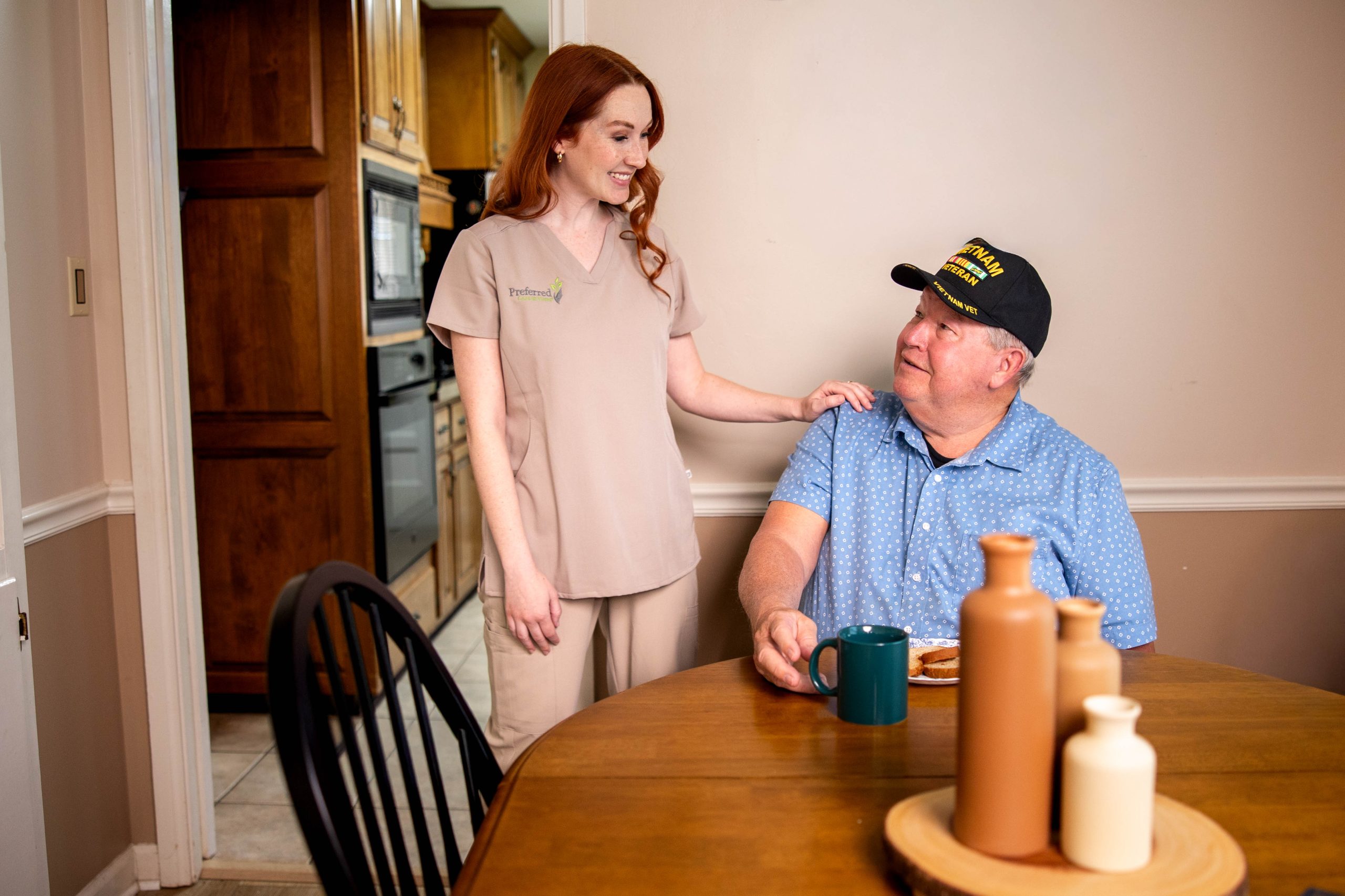

Most families assume the choice is binary: either it’s just aging or it’s Alzheimer’s. That framing skips over the middle category where most of the worry actually lives, and where most of the useful decisions get made. This guide walks through what normal aging looks like, what mild cognitive impairment means, and when daily-life changes signal it’s time to call a doctor. At Preferred Care at Home of Apex, Garner, and Fuquay-Varina, our owner Michael Murphy is a Certified Senior Advisor (CSA).
Key Takeaways
- Per the CDC, about 1 in 9 Americans age 65 and older live with dementia, but routine memory slips often aren’t part of that picture
- Mild cognitive impairment is the middle ground between the normal aging process and dementia
- When bills, medications, driving, or cooking start slipping, it’s time to talk to a doctor
- In-home support can stabilize daily routines while your family seeks answers
What Normal Aging Looks Like (and When It Isn’t)
Normal age-related memory change has one defining feature: it doesn’t disrupt daily life. According to the CDC’s guidance on dementia symptoms, the working line is whether your loved one can still complete the everyday tasks they always have. A momentary blank on a word, a misplaced set of keys, forgetting an acquaintance’s name at the grocery store: these are a natural process that comes with aging.
Here’s what tends to fall inside that line:
- Forgetting an acquaintance’s name but recognizing the face
- Occasionally misplacing keys or glasses, then retracing steps and finding them
- Pausing mid-sentence to search for the right word, then getting it
- Needing a beat longer to recall a recent event, but recalling it
- Forgetting why you walked into a room
- Some slowing in learning new technology
According to the CDC, an estimated 6.9 million Americans age 65 and older are living with dementia, about 1 in 9 older adults.
Healthy aging does involve some change in nerve cells and brain volume, but it’s the daily-life test that distinguishes typical aging from something on the dementia care spectrum. Age-associated memory impairment is a term doctors use for memory changes that come with typical aging but don’t reach the threshold of concern. Memory loss that’s a normal part of the aging process doesn’t interfere with your ability to live a long and healthy life. What about the changes that sit in between, where daily life isn’t disrupted yet but something feels off?
The Middle Ground: Mild Cognitive Impairment
A clinical review in PMC reports that mild cognitive impairment affects 10% to 20% of adults age 65 and older.
Mild cognitive impairment (MCI) is the term most families have never heard, and it’s where most of the worry actually lives. In plain language, mild cognitive impairment MCI means a noticeable decline in mental abilities (memory, language, problem solving) that’s beyond typical aging, but not severe enough to interfere with daily life the way dementia does. Your mother still pays her bills and drives to church, but she’s asking the same information twice in one conversation.
Age-associated memory impairment is another term you might hear, referring to memory issues that come with increasing age but don’t reach the threshold of MCI. The differences between normal aging and mild cognitive impairment can feel subtle, but they matter when you’re deciding whether to call the doctor. Understanding the differences between normal aging and early Alzheimer’s helps families recognize when memory loss crosses from typical aging into something that needs medical attention.
Signs that lean toward MCI rather than typical aging:
- Losing track of recent events the rest of the family clearly remembers
- Asking the same question or repeating the same story within one visit
- Difficulty learning a new routine that used to come easily
- Difficulty concentrating on familiar tasks like a recipe or a bill
- Word-finding trouble that’s frequent enough that family members start noticing
Here’s the part that surprises most families: MCI isn’t a sentence. A PMC review reports that about 20% of patients diagnosed with MCI return to normal cognition on follow-up examination. Some cases are caused by treatable conditions like medication side effects, sleep problems, depression, or thyroid issues. That’s a real argument for getting an evaluation early rather than waiting. That’s why a side-by-side picture, not a single symptom, is what actually helps families decide what they’re seeing, including when to consider Alzheimer’s care as part of the conversation.
Side-by-Side: Normal Aging, MCI, and Alzheimer’s
Here’s what the three look like in everyday life. Each row describes a behavior a family member would actually notice at the dinner table, on a phone call, or during a drive across town.
| Area | Normal Aging | MCI | Alzheimer’s / Dementia |
| Memory | Misplaces keys sometimes, then finds them | Forgets recent conversations more often | Forgets recent events and asks the same questions repeatedly |
| Language and Words | Occasional pause searching for a word | Noticeable trouble finding the right word | Difficulty speaking or following a conversation |
| Daily Tasks | Manages bills, meds, and cooking on the usual schedule | Takes longer, may need lists or reminders | Unable to complete familiar tasks or manage bills safely |
| Navigation | Drives familiar routes without trouble | Hesitates in unusual places, may avoid driving at night | Gets lost in a familiar neighborhood or places items in unusual places |
| Behavior | Typical personality, typical moods | Mild frustration or worry about memory problems | Behavior changes, withdrawal, emotional regulation issues |
The most useful row is the daily-tasks row. That’s where the line between “schedule a routine checkup” and “act soon” usually gets drawn. A clinical review reports annual progression to dementia of 10% to 15% in people with MCI, compared with 1% to 2% in older adults without cognitive impairment. So MCI doesn’t always become Alzheimer’s, but the odds are different enough that the next section is the one that matters most.
Understanding the early signs of Alzheimer’s disease helps families act before the disease progresses. Early Alzheimer’s affects brain regions responsible for memory formation first, which is why memory loss is often the earliest symptom families notice. Early detection and early diagnosis can open doors to treatment options and support services that make a real difference in quality of life and well being. Recognizing signs of dementia early, including changes in mental abilities and problem solving skills, gives families time to plan.

When Daily Life Is the Real Threshold
When the memory question gets fuzzy, the daily-life question gets clear. The NIA on cognitive health and older adults frames cognitive health around four anchor activities: driving, paying bills, taking medicine, and cooking. If any of those four is slipping, you have your answer about what to do next.
Use this as a one-week check:
- Has your loved one missed bill payments or had a utility disconnected recently?
- Have you noticed pills left in the weekly organizer at the end of the week?
- Have they gotten lost on a familiar route, or quietly stopped driving routes they used to take?
- Have they left the stove on, or repeated steps when cooking a familiar meal?
- Are they asking the same question more than once in a single conversation?
- Have they forgotten a recent event that the rest of the family clearly remembers?
If any of those is a yes, call the primary care doctor and ask for a cognitive evaluation. Bring a written list of the changes, roughly when they started, how often they happen, a current medication list, and any family history of dementia. The doctor will rule out treatable causes first. Per the CDC, noticing your own worsening confusion (subjective cognitive decline) can be an early sign, but it isn’t a diagnosis on its own.
As people age, cognitive abilities can shift in ways that feel confusing. Some changes are a normal part of the aging process, while other symptoms point to an underlying medical condition that needs attention. The key is watching how your loved one completes everyday tasks. When routine activities become increasingly difficult, when your father can’t remember how to work the coffee maker he’s used for 20 years, or your mother starts to forget things she told you an hour ago, that’s when the conversation with a doctor becomes urgent.
While you’re waiting for appointments, companion care can keep daily routines steady at home, including meal support, reminders, and a second set of eyes on what’s actually happening day to day.
What to Do Next for Wake County Families
In the next 30 days, do three things: book the cognitive evaluation, keep a simple log of changes (when, what happened, how often), and protect your loved one’s routines around sleep, meals, and social contact. Routine is the single most stabilizing thing during the wait, and the log is what makes the appointment useful. Lifestyle choices around diet, exercise, and social engagement support cognitive health during this period.
We hear this conversation often in Wake County, where roughly 13.7% of residents are age 65 or older per the U.S. Census Bureau, and families across Apex, Garner, Fuquay-Varina, Holly Springs, and Clayton are working through it in real time. Preferred Care at Home of Apex was founded by Michael Murphy, a Certified Senior Advisor. When you call, you reach him directly.
During the diagnostic period, in-home support can cover companionship, help with daily routines, medication reminders, meal prep, and supervision, plus respite care so the family caregiver in your house gets a real break. If routines or safety are slipping at home, call (984) 246-8900.
Frequently Asked Questions
What is the difference between normal aging and dementia?
The working difference is whether the memory changes disrupt daily life.
Normal aging includes occasional slips like forgetting a word or misplacing keys, but the person still manages bills, meals, medications, and driving on the usual schedule. Dementia interrupts those daily tasks: bills go unpaid, pills get missed, familiar routes become confusing. The slip itself matters less than whether everyday life keeps running. The person’s ability to complete tasks and maintain their well being is what separates typical aging from signs of dementia. Understanding the differences between normal aging and Alzheimer’s disease helps families know when to seek medical evaluation.

What is mild cognitive impairment?
Mild cognitive impairment is a decline in memory or thinking that’s noticeable but doesn’t yet disrupt daily life.
MCI sits between normal aging and dementia, and it’s both a stage and a state. A PMC review reports about 20% of patients diagnosed with MCI return to normal cognition on follow-up examination. Some cases are caused by treatable issues like medication side effects, sleep problems, or thyroid conditions, which is why an early evaluation matters. Mild cognitive decline doesn’t always lead to developing Alzheimer’s disease, but monitoring changes helps families stay ahead of what’s coming. Age-associated memory impairment is milder than MCI and often remains stable without progression.
Can forgetting names be normal aging?
Forgetting an acquaintance’s name is usually a normal part of aging, but forgetting close family members is worth a doctor’s visit.
Most older adults occasionally blank on the name of a neighbor or a former coworker, then recover it later. That’s part of typical aging. What’s different is forgetting the name of a spouse, a child, or a grandchild you see every week, or struggling to place who someone is rather than just what they’re called. That second pattern belongs in a conversation with the primary care doctor. It’s normal to forget things occasionally, but when memory lapses affect close relationships, it’s time to get checked. Early Alzheimer’s can show up as difficulty remembering names of close family.
When should memory problems be checked by a doctor?
When daily decisions start getting harder.
The clearest trigger isn’t worry, it’s function: missed bills, pills left in the organizer, getting lost on a familiar route, the stove left on. If any of those is happening, schedule a cognitive evaluation now and ask the doctor to rule out treatable causes. While you sort it out, Preferred Care at Home of Apex can keep daily routines steady at home. Difficulty carrying out everyday activities is one of the key aspects doctors look for when assessing cognitive function. Changes in problem solving or mental abilities during routine tasks are also worth discussing.
Is getting lost a sign of Alzheimer’s?
Getting lost in a familiar place is a meaningful sign and worth a doctor’s visit.
There’s a real difference between getting briefly turned around in an unfamiliar parking lot and not recognizing your own neighborhood on the drive home from the grocery store. Per the CDC, getting lost in a familiar neighborhood is a telltale sign of dementia. One missed turn isn’t the issue. A pattern of confusion on routes your loved one has driven for years is. Spatial disorientation in the early stages can be subtle but shouldn’t be ignored. Early Alzheimer’s often affects spatial navigation before other cognitive abilities decline.
At what point do repeated questions stop being senior moments?
When the same question comes back within minutes and the prior answer doesn’t stick.
A senior moment is asking something, getting the answer, and remembering it. The pattern that matters is asking the same question two or three times in one conversation with no recall of the earlier answer, or repeating a story to the same person inside the same visit. If that’s the rhythm, talk to the doctor. In the meantime, companion care can ease the daily strain on the family. Tangles play a role in Alzheimer’s disease progression, but families don’t need to understand the biology to recognize when something’s wrong.
How can home care help if we are not sure it is dementia yet?
In-home care during the diagnostic period stabilizes routines and gives the family caregiver room to breathe.
You don’t need a diagnosis to need help. At Preferred Care at Home of Apex, Garner, and Fuquay-Varina, caregivers can cover companionship, meal prep, medication reminders, light housekeeping, and supervision while your family works through evaluations. That keeps your loved one’s days steady and gives the relative who’s been carrying most of it a real break. Healthy aging at home is possible with the right support, even when cognitive abilities remain intact but daily tasks need a little extra help. Whether it’s age-associated memory impairment or early signs of Alzheimer’s disease, in-home support provides stability during uncertain times.