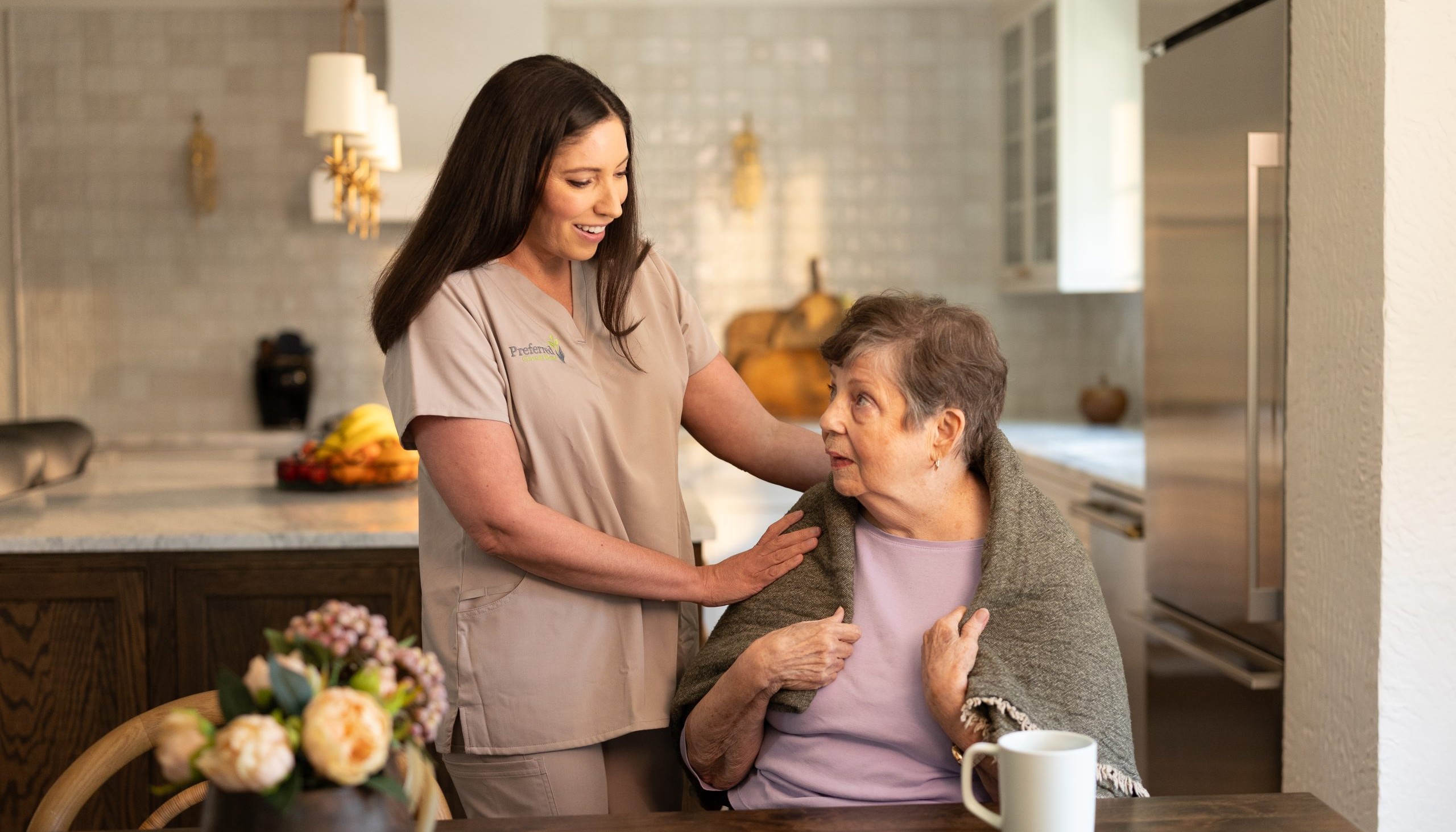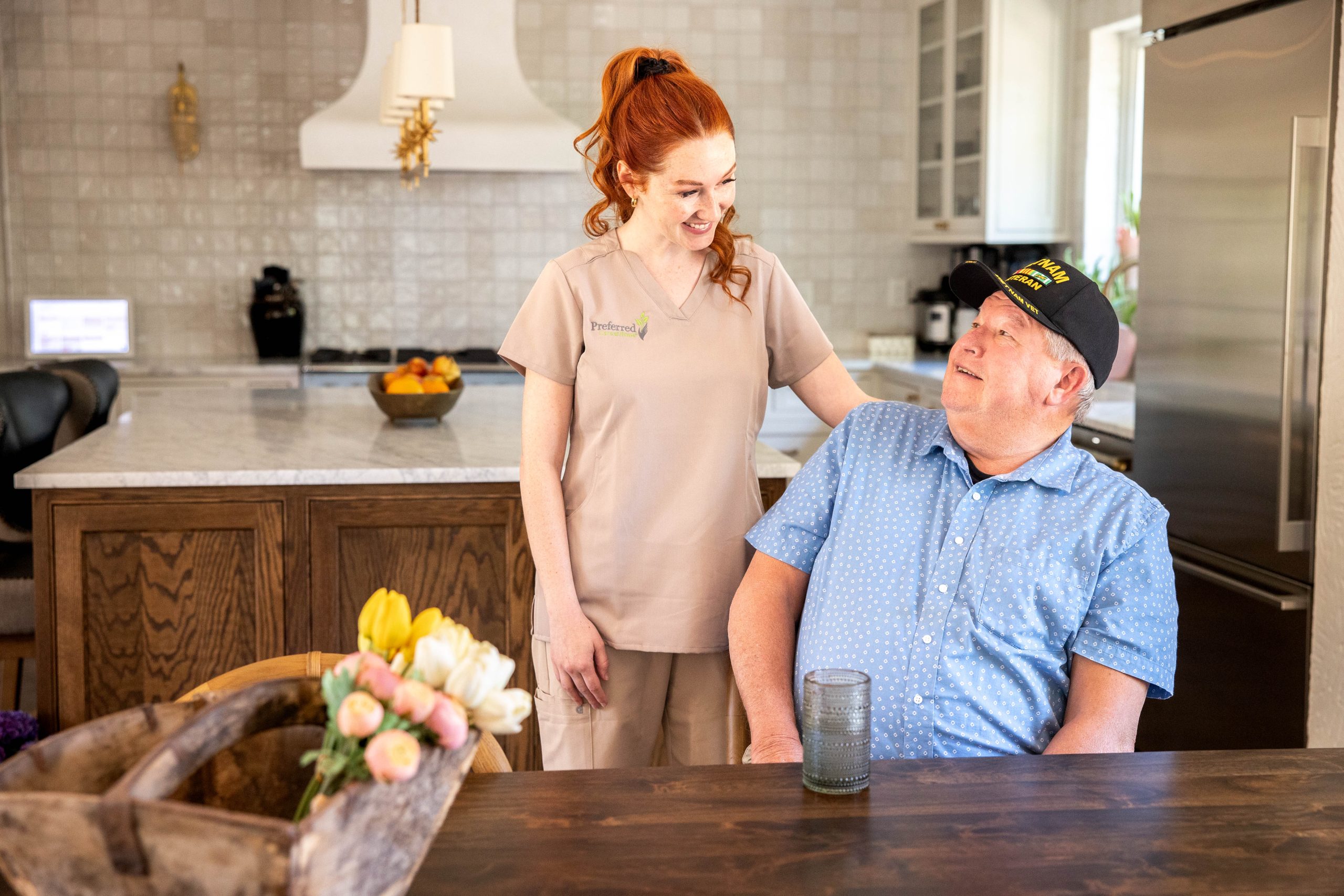
Helping a loved one with Alzheimer’s disease isn’t the same as helping someone remember things. The role grows month by month into a long, layered job that touches daily routines, safety, family decisions, and your own health. This guide gives you a practical framework for daily care, the safety triggers to watch for, and how to know when it’s time to bring in support. Preferred Care at Home of Virginia Beach was founded by a family member who lived through this same question, and dementia care is what we built our work around.
Key Takeaways
- 80% of adults with Alzheimer’s receive home care (CDC).
- Virginia: 333,000 caregivers provide 561 million unpaid hours annually.
- Six in ten with dementia will wander at least once.
- Asking for help is a care strategy, not failure.
What Helping Looks Like as Alzheimer’s Progresses
Most families step into this role expecting memory reminders and patience. The actual work is bigger. Helping a loved one with Alzheimer’s disease becomes a multi-year role where the person with dementia needs a care partner for many tasks at once, and the family member at the center of it slowly becomes the primary caregiver for a life that used to run itself.
In the early stages of Alzheimer’s disease, the work often looks like cueing and quiet support. As dementia progresses, the day shifts. What changes over time:
- Short term memory loss makes routine tasks harder to start and finish
- Communication shifts, so facial expressions and body language carry more meaning than words
- Safety risks evolve (wandering, falls, swallowing), which we cover in the next sections
- Mood and behavior changes appear because the brain is changing, not because the person has changed
- One family caregiver often ends up coordinating medical, household, and emotional support at the same time
The person with dementia experiences these changes in their own way, and each person’s timeline is different. Specialized in-home memory care can step in at any point along that arc. What matters is naming the role for what it is, so family caregivers can plan for the years ahead instead of reacting week by week.
Daily Care That Supports a Loved One With Alzheimer’s at Home
According to the CDC, about 80% of adults with Alzheimer’s and related dementias receive care in their homes.
Home is where most of this care happens, which means the family is doing it. The day works better when communication and routine are designed around how the brain is changing, not how it used to work. Practical strategies for daily care start with understanding what the person with dementia can still do, then building structure around those abilities.
Communication That Reaches Past Memory Loss
Conversation is one of the first things to shift. Strong communication skills help your loved one feel calm and understood, even when the words don’t land.
- Use simple words, one idea per sentence
- Maintain eye contact and slow your pace before you start the sentence
- Let your body language and facial expressions match a calm tone
- When the same question comes up again, answer it like it’s the first time, because short term memory loss makes repetition normal
- Skip the correction; meet the person where they are emotionally
Validating his or her feelings matters more than correcting facts. The person with dementia is responding to what feels real in that moment.
Routine, Activities, and the Day That Works
A steady daily routine is one of the most powerful coping strategies a family has. It reduces decisions, lowers anxiety, and protects energy for the moments that matter.
- Anchor everyday tasks (meals, rest, one familiar personal activity) at the same times each day
- Use household chores the person can still do, like folding towels or sorting mail, to keep purpose alive
- Pair physical activity with something the person enjoys, so a short walk feels like time together
- Plan personal activities and group activities for the part of the day when your loved one is most alert
- Offer nutritious foods at predictable times, because eating becomes harder later
Companionship is part of the care plan, not a luxury. Many families bring in senior companion care services for a few hours a week so older adults can spend time with someone steady, and the family member at home gets a break.

Safety Triggers That Change What’s Needed at Home
According to the Alzheimer’s Association, six in ten people living with dementia will wander at least once, and many will do so repeatedly.
Safety with Alzheimer’s isn’t general home safety. The risks are specific, and they show up earlier than most families expect. Tracking four trigger categories helps you see what’s changing before it becomes a crisis.
- Wandering: Add locks on exterior doors, walk through a home safety checklist, and consider an ID bracelet or registered locator. The first episode often happens before the family thinks it’s possible. Alzheimer’s Association guidance on wandering is a strong starting point.
- Eating and swallowing: If your loved one starts coughing while eating or drinking, talk with their doctor. The NIA flags this as a change that needs medical evaluation, not a kitchen fix.
- Medication routine: Medication reminders matter. Pillboxes, set times, and a written list of what’s taken each day reduce missed or doubled doses, and they keep one source of truth for the family.
- Behavior changes and difficult behaviors: Mood swings, moments when people with dementia feel confused, and verbal or physical aggression are part of how the brain is changing, not personal choices. Adjusting the environment (less noise, fewer choices, simpler rooms) usually does more than reasoning with the person.
Safety concerns shift as the disease progresses, so the safety features that worked last spring may not work this fall. Difficulty remembering recent decisions can also turn ordinary moments (a hot stove, an unlocked car) into real risk. Behavioral problems and physical aggression tend to peak when something basic is unmet, so checking for pain, hunger, or fatigue first often prevents more harm. Walk the house and the routine again every few months. For incontinence management, keep incontinence pads stocked and accessible so the person with dementia can maintain dignity during personal care moments.
When Family Caregiving Alone Isn’t Enough
Most families ask this question privately long before they say it out loud. Is it still okay for me to do this on my own? The honest answer is that needing help isn’t a sign you failed. It’s a sign the disease has progressed.
According to the Alzheimer’s Association’s Virginia Facts Sheet, 21.6% of dementia caregivers in Virginia have depression and 28% report poor physical health.
That data names one of the greatest challenges of this role: your mental health and well being slip while you’re focused on someone else’s. Use the table below to compare what you’re seeing at home against the moment when family-only care stops being enough.
|
Sign at Home |
Family-Only Care May Still Work |
Time to Add Outside Help |
|
Wandering |
Person hasn’t wandered; doors and routines secure |
Even one wandering episode has happened |
|
Eating and swallowing |
Eating is steady, no coughing during meals |
Coughing while eating or weight is dropping |
|
Caregiver health |
Sleep and routines are intact |
You feel frustrated daily; your own health is slipping |
|
Care duration |
Recent diagnosis, manageable hours |
You’ve been the primary caregiver for over a year |
|
Behavior changes |
Mood shifts are occasional and manageable |
Verbal or physical aggression has appeared |
If the right column describes even one row, it’s time to call. That’s not giving up. That’s the next step.
Respite care, support groups, and daily living assistance for seniors all exist so the family caregiver can keep going. Other family members and a close friend can help carry pieces, but the emotional support and social support that come from professional respite are different in kind. And if your loved one is coming home from a hospital stay, Transition Care can bridge those first weeks so you aren’t catching everything alone.
Self care isn’t separate from your loved one’s care. It’s how you remain healthy enough to keep showing up, and how many families feel confident handling things personally for the long haul. Both you and the person with dementia benefit when the care plan includes outside support.
Virginia Resources for Families Caring for a Loved One With Alzheimer’s
According to the Alzheimer’s Association’s Virginia Facts Sheet, 333,000 Virginia caregivers provide 561 million hours of unpaid dementia care each year, valued at $12.8 billion.
You aren’t navigating this alone. Virginia has built specific pathways for families helping a loved one with Alzheimer’s, and the Hampton Roads area sits inside that network. A few local resources and other resources are worth knowing by name:
- Area Agencies on Aging (AAAs): Free options counseling, caregiver support, and community resources. Virginia DARS connects families to their regional AAA.
- Dementia Care Management Programs: Virginia DARS supports these programs at no cost to participants in several regions across the state, and other caregivers in the program become part of the support network.
- Virginia Dementia Road Map and Virginia Navigator: State-built tools that help you find respite, support groups, and wandering registration.
- Alzheimer’s Association 24/7 Helpline (800-272-3900): Crisis assistance, local resources, and care consultations available around the clock, in 200+ languages. This support line connects you to immediate help.
The National Institute on Aging also offers guidance and research updates for families, including current clinical trials. Your local library often carries caregiver resource guides and can connect you to community programs.
Preferred Care at Home of Virginia Beach is part of that local network. We’re locally owned, VA-contracted, and dementia and Alzheimer’s care is the heart of how we built our work, because the person experiences this disease in their own way and patient care has to start from there. We serve families across the Hampton Roads area and assist with Long Term Care insurance, including eliminating the elimination period on most policies. If you’re early in this and just want to talk through what’s happening, that’s reason enough to call. Schedule a Consultation and we’ll walk through it with you.
Frequently Asked Questions

How do you help a loved one with Alzheimer’s?
Build a daily routine, plan for safety, communicate with patience, and bring in outside help before you burn out.
Helping a loved one with Alzheimer’s starts at home for most families. The role grows as the disease progresses, so the work is daily care, safety planning, communication that meets the person where they are, and recognizing when family-only care is no longer enough. Nearly 1 in 3 family caregivers provide care for four years or more, according to the CDC. The person with dementia depends on structure, patience, and a care partner who understands that behavior changes come from the disease.
What should you not do with someone with Alzheimer’s?
Don’t argue with their version of reality, don’t rush them, and don’t assume planning can wait until things get worse.
Correcting facts often increases agitation without helping memory. Don’t rush conversations or routines, because slow pacing reduces difficult behaviors. And don’t wait on planning. The NIA recommends starting advance care planning early because decision-making ability can decline earlier than families expect, often before the person can fully participate in choices about care, finances, or daily life. The person with dementia deserves to shape their own care plan while they still can.
How do you calm someone with Alzheimer’s?
Match their feelings first, then reduce the noise, light, or choices around them before trying to redirect.
Calming starts with body language and facial expressions, not words. Speak slowly, sit at eye level, and acknowledge what your loved one is feeling before you explain anything. Reduce sensory input by turning off the TV, clearing the room, and offering simpler choices. Most behavior changes and mood swings come from confusion or unmet needs (pain, hunger, fatigue), not from the conversation itself. The person with dementia is reacting to what feels overwhelming or frightening in that moment, and your calm presence is the anchor.
How do I get a break without upsetting my parent?
Start small with a few hours of respite care a week, and introduce the helper as a friend or companion, not a replacement.
Many families wait until exhaustion before asking for help. Burnout is measurable, not personal weakness. Preferred Care at Home of Virginia Beach matches caregivers by personality, so the first visits feel familiar instead of disruptive. Explore daily living assistance for seniors as a starting point. A few hours can change a week. The person receiving care often adjusts more easily than the family member expects, especially when the new caregiver brings warmth and consistency.
How do I know when home care is no longer enough?
When wandering, swallowing problems, or daily caregiver exhaustion show up, it’s time to plan the next layer of support.
The signs are concrete, not vague. Wandering is one of the clearest, and the Alzheimer’s Association reports that 6 in 10 people with dementia will wander at least once. Coughing during meals, missed medications despite reminders, and verbal or physical aggression toward the caregiver are the next-step signals. So is your own health: if you’re frustrated daily or your sleep is gone, that’s part of the assessment. Talk through your situation with someone who does this every day.
How do I find respite care for a family member with dementia in Virginia?
Start with your local Area Agency on Aging through Virginia DARS, the Alzheimer’s Association Helpline, and an in-home care consultation.
Virginia DARS connects families to their local Area Agency on Aging, where options counseling and respite referrals are free. The Alzheimer’s Association 24/7 Helpline at 800-272-3900 offers care consultations and local resources around the clock. For in-home respite, Preferred Care at Home of Virginia Beach matches experienced caregivers across Virginia Beach, Chesapeake, and the wider Hampton Roads area, and assists families with Long Term Care insurance claims. Respite gives the family member a chance to rest, and it gives the person with dementia a chance to build trust with a new caregiver before more support is needed.